Jesus Brings Division? Catholica.com

“Do you think that I have come to establish peace on the earth? No, I tell you, but rather division. This is what it will be like. It will be as if a household of five were divided, three against two and two against three…”  From Luke 12:49-53

“At present there is increasing talk of schism. Will it be necessary for conservatives to separate, as the Old Catholics in Holland did after Vatican I? Or is it time for progressives to break away and form ‘The People of Vatican II’ as some are advocating?

In the end the question is, can we be in communion with people who have different thoughts and attitudes to ours? Historically, when divisions occur, at some point we break off communion. Religious people, whether catholics or protestants, christians, muslims or jews, take the matter of being ‘in communion’ very seriously. We value purity of doctrine above family bonds. We can’t break bread with you! This is very sad. It is very odd. I wonder is this the aberration that Jeshua knew they would not avoid?

What is the ‘unity’ he prayed for? Was it uniformity of thought and expression in a world whose very evolution and development is a product of diversity? Was it conformity that is changeless in a living world where adaptation to different environments is the rule of life’s survival? Was it to be unchanging in a cosmos where there is nothing that is not moving? Sameness, permanence, being still: these are all illusion.
Or was he thinking of a family bond that would hold us together, even while we find many different paths through life. Unity in diversity.

What is the touchstone? What is the bond that makes us one? Why do our divisions hurt more than the divisions that are part and parcel of politics in a democracy, of business interests, of sport and even of football codes? Why do we treat difference in our Christian Family as worse than criminal? Why do we cut off communion and refuse to talk with the ‘others’? Is it reasonable? Or is it childish recoil from the pain of family hurt where any disharmony is magnified into trauma.

I believe that, in the last analysis, it’s a matter of trust.
We do not trust those who are different, or go a different way. The sad fact is that our rejection of them shows that we do not trust God to lead them along their paths. We judge them because the thought that there might also be another way threatens our security. Without understanding them, we reject them on the measure of our own perception of the truth. To cement our stance in place we all claim that God’s approval makes our position absolute.  Children! Children! Behave yourselves. Remember where you are!

In our Father’s house we must first trust him. It is the embodiment of believing – to trust. It takes faith out of the airy intellectual and makes the heart big enough to embrace other sisters and brothers, God’s other children. It is not foolish or irresponsible to trust God. But it is silly to try to run his world our way.”

Article excerpt reprinted with permission.

Click link below to read Full article by Tony Lawless at Catholica.com:
He Brings Division? Sunday Readings


Garden Sin of Origin, Original Sin?


Garden Sin of Origin (audio version)

Text:

 Before sin, Adam and Eve walked and talked with God, freely and openly—no boundaries.  Suddenly God sets limits.
“Don’t eat of this tree.” “This tree is My space.”

Suddenly love defines differently. No longer you = me or me = you in womb-like comfort. Homey oneness get a push away to make room for ego-separateness, for self, for one’s transcendent mystery, for God’s transcendent mystery.

For Adam and Eve, womb-like intimacy gets a jolt and ego is born infantile.
“Poor me, God is not sharing everything with me. God must be holding something back so He can be over me. I am deprived. Let me eat of the tree and I shall be like God.”

Original Sin—Invading God’s Space…Violating Transcendence?

“Do not eat of the Tree of the Knowledge of Good and Evil.”   Was it a test? Or was God defining Divine space—the Tree of Knowledge of Good and Evil. Was this never meant to be our space?

Was eating of this tree an unintentional effort to cross boundaries with God…an unconscious effort to blot out the loneliness of self and vanquish it by invading the Other? If so, eating of this tree was denying God’s Otherness, an attempt to steal into the unique mystery of the other justified by the childish whim that love must have no boundaries. Love with boundaries was something Adam and Eve could not yet understand.

Ego boundaries were the one thing God couldn’t give Adam and Eve.
Ego must discover its own separateness and come to honor it.
Presumably, God could have forgiven Adam and Eve and allowed them to remain in the Garden, but how could Love do that?   The Garden was no place for ego development anymore than the womb is place for such development.

Adam and Eve needed an environment where they could experience themselves as separate from God in order to learn a sense of unique and individual self.
Without knowing that, they could never understand how to relate with God as adults.
And certainly God had no mind to keep them ever-children.
O Happy Fault!  Garden Sin of Origin, O HAPPY FAULT!

by Sister Lea

https://RiteBeyondRome.com

¿En serio? “El próximo Cisma…Ya está aquí”

Translation of RITE BEYOND ROME document  <Really? “Next Schism Already Here”>

Phyllis Zagano inicia esta página con su artículo publicado en el National Catholic Reporter:

“El próximo Cisma no se encuentra lejos en el camino, ya está aquí. Sus ponentes bien alineados para una seria confrontación, con las camisetas de su equipo bien puestas, luciendo los emblemas “Pre-Vaticano II” y “Post Vaticano II”

La fisura se está agravando, ya que más y más jóvenes van llegando, con el deseo, con la apetencia por aquellos buenos tiempos (que existieron antes de que ellos nacieran) cuando había un orden general, cuando cada cosa tenía su lugar y se seguían las reglas.”

https://www.ncronline.org/blogs/just-catholic/next-schism-already-here

La Respuesta de Sister Lea’s está en National Catholic Reporter”

“Esta guerra verbal… entre los Católicos buenos contra los Católicos malos y en la que la definición de “buenos” y “malos”, depende del lado en que estás… ¿cuánto tiempo va a prolongarse esta guerra?

Que enorme daño se están haciendo las dos posturas entre si y a la Iglesia por no creer que en las dos hay buena voluntad!

Que escándalo le estamos dando a nuestros niños y luego nos preguntamos porque tienen tan poco o ningún deseo de pertenecer a nuestra Iglesia.

No hay duda que existen católicos que necesitan desesperadamente, certeza y seguridad en este mundo tan rápidamente cambiante…esto podemos entenderlo.

¿Será necesario que el lado Post-Vaticano II se mofe y vilipendie a quienes están en la posición del Pre-Vaticano II por su visión de salvar al mundo aferrándose al entendimiento y prácticas “tradicionales” de la doctrina… nosotras podamos ver que algunos de esos valores están pasados de moda, o distorsionados y finalmente no-Cristianos- No hay duda que ellos nos ven de manera similar.

Y sí, si hay Católicos que sienten la desesperada necesidad de un cambio en la Iglesia… un cambio que no puede esperar 50 o 500 años… por lo mismo el tiempo apremia esta necesidad, dentro de la visión de la Iglesia como la Roca de Pedro en lugar de la de la Barca de Pedro en mar abierto.

¿Será necesario que el lado Pre-Vaticano II se mofe y vilipendie a quienes estando en la Iglesia ven al Vaticano II de una manera diferente a como ellos lo ven? ¿Es acaso necesario que ellos denuncien como herejía cualquier deseo o intento por de-construir la tradición con el fin de continuarla más fielmente en el mundo actual? ¿Es necesario que nos acosen y persigan por no ser capaces de pensar como ellos, así como ellos también son incapaces de pensar como nosotros?

Un Cisma no es la respuesta para ninguno de los dos lados. El Árbol de la Familia Católica, se inició de una Raíz en Jerusalem, extendiendo sus ramas en tres diferentes tradiciones: Roma, Antioquía y Alejandría.

Necesitamos una rama nueva en la Iglesia, la del Vaticano II, algo como lo que dice el Teólogo Daniel Maguire en su artículo de Crux 9.13.15. “El Catolicísmo ¿seguirá el camino del Judaísmo?” ( con sus tres ramificaciones: Ortodoxa, Conservadora y Reformada).”

Leer: “¿Una ramificación totalmente nueva?” y otros artículos en https://RiteBeyondRome.com

Muchas gracias a Luisa Maria Rivera por su traducción de este artículo!


“Huge gap separates Pope Francis from liturgical traditionalists” by Massimo Faggioli

Our comment below on Massimo Faggioli’s article…comment censored by Global Pulse Magazine  (GPM article link below):

“We appreciate Massimo Faggioli’s hope that Vatican II Church is going to make a come-back. However, in the few short years Pope Francis has, do you really believe he can reverse the massive “particular sympathy and irenic attitude” towards traditionalism” imbibed by the Catholic population and taught in many universities, seminaries, parishes and publications worldwide for the past 30+ years?

Furthermore, with the dying off of so many Vatican II Catholic clergy, theologians and laity, should we really sit back and depend on Pope Francis to revive the Vatican II Church…against the strong and pervasive traditionalist push for a “smaller, purer Church”?

Fact is, the Roman Rite of the Catholic Church has set itself up as a formidable opponent to Vatican II and its prophetic interpretations of theology, governance, liturgy and Catholic identity.  So why not let elder brother Rome stand guard over Council of Trent hermeneutics as the representative of institutional Catholicism?

Meanwhile, Pope Francis is in a position to liberate Vatican II from the hands of those who shall never see Vatican II  as anything more than a confirmation of the Council of Trent.

Pope Francis can protect the universal Church from schism by blessing the Trentonian and Vatican II traditions as “equally valid yet different” branches of Catholic thought and practice.

This move would be somewhat akin to the “separate yet one-with” brotherhood of Roman and the Eastern Church Catholicism which has a less scholastic/more mystical interpretations of Catholic theology, governance and liturgy than its Roman “elder brother”.

Otherwise, Francis dies and the Church moves comfortably back into its Curial mode of Trent Council Catholicism, as if Vatican II never really happened, no?”

Massimo Faggioli’s article: “Huge gap separates Pope Francis from liturgical tradionalists” – Global Pulse Magazine
http://www.globalpulsemagazine.com/news/huge-gap-separates-pope-francis-from-liturgical-tradionalists/3568     (article published 7.18.2016)

Dare We Catholics Believe Differently?

Have we even begun to understand what degree of change the Holy
Spirit was/is calling forth from within the event of the Second Vatican Council?

Some Catholics see the past few decades…from a different viewpoint…
…as an erosion of faith in the doctrines we have…

But others look at Vatican II as a gift of the Holy Spirit,
as God calling forth a whole new perspective on doctrine…
in which case, there is the need for a very deep deconstruction of
“how we believed before and often still do now.”

A deconstruction of Catholic belief
down to the very bedrock of our faith…

leaving behind
cherished understandings of doctrine…
in order to get to the root of doctrine
and its applications for our time.

NOT to change or break down Roman Rite theology …
which keeps the institution focused on certainty and security in the everyday world,
…
BUT to be a “next-door” theology in union with Rome…
……..from the point of a world constantly adapting to change…
…that each theology may call forth and challenge the other 
in our uncommon faith
in Jesus the Christ and our proclamation of the Good News to the world.

Uncommon Faith speaking from two different perspectives:

+Roman Rite Catholicism from the perspective of the “strong force” of a
…hierarchical, unchanging, all-knowing, all powerful God who is everywhere,
a God who designed the universe according to the order of His Will.

+ Vatican II Rite Catholicism from the perspective of the “weak” strength of a
…God that calls and promises but doesn’t command, awaits response but doesn’t demand.
The Name of which God carries an event that stretches us
beyond what we know to where we are certain we must go,
to an order other than hierarchy (the internal order of chaos theory perhaps),
…a divine “stepping back” which reveals how much we tend to rely on force as power,
…a divine will that models and solicits forgiveness, hospitality and love of the other
as the determining factors of who discovers or “gets into” the kingdom of God

More on Vatican II Theology to come on Rite Beyond Rome.
Meanwhile, read John D. Caputo’s books:
On Religion and The Weakness of God, A Theology of the Event with us.
Interested in conversation…comment below and/or email 4Vatican2Rite@gmail.com

View, share, download:
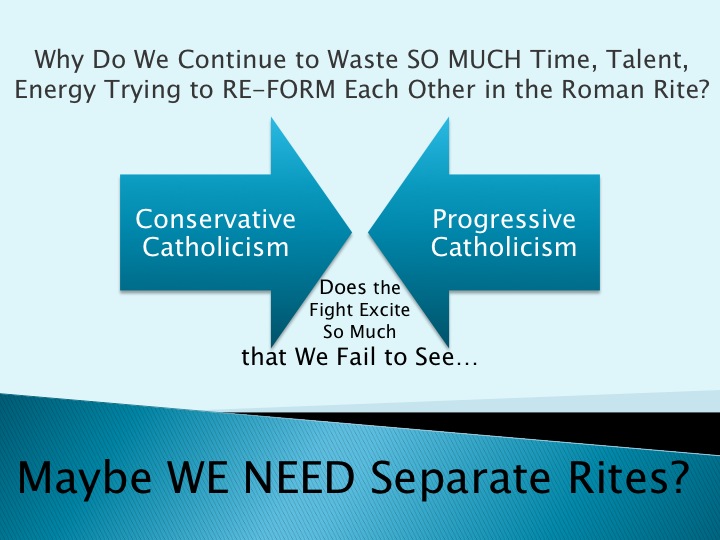
Slide Presentation: EXPLORING A VATICAN II RITE

Position Paper:  Resolving Polarization of Vatican II and Roman Catholic Visions

Sisters Lea and Consilia
https://ritebeyondrome.com

Really? “Next Schism Already Here”

Phyllis Zagano starts out here with her article on National Catholic Reporter:

“The next schism isn’t down the road somewhere. It is already here. The proponents are lined up in a serious face-off, their team shirts emblazoned “Pre-Vatican II” and “Post-Vatican II…

The fissure is getting worse, as more and more younger people come along yearning for the good old days (before they were born) when everything was orderly, everything had its place, and the rules were followed.”

https://www.ncronline.org/blogs/just-catholic/next-schism-already-here

“This verbal war…the one of the good Catholics against the bad Catholics, with “good”or “bad” being defined by which side you are on…how long must that war endure?

What Massive Harm the two sides are doing to each other and the Church by not believing in each other’s good will!
What scandal we give to our children and then wonder why they have little or no desire to remain in our Church!

So, there are Catholics who desperately need certainty and security in this rapidly changing world…one can understand this.

Must the post-Vatican II side deride and vilify the pre-Vatican II side for their vision of saving the world by hanging on to “traditional” understandings of doctrine and practice…even though we might see some of those values as outmoded, distorted, even un-Christlike?  Surely they see us in a similar light.

And yes, there are Catholics who see the desperate need for change in the Church…change that cannot wait 50 or 500 years more…whereby time presses that need under the vision of Church as Rock of Peter rather than Barque of Peter on the open sea.

Must the pre-Vatican II side deride and vilify those in the Church who see Vatican II differently than they do? Must they denounce as heretical any desire or attempt to deconstruct tradition in order to follow it more faithfully in our time? Must they harass and hound us for not being able to think like them anymore than they are unable to think like us?

SCHISM IS NOT THE ANSWER FOR EITHER SIDE. The Catholic Family Tree started out from one Root in Jersalem, branching out into three different traditions of Rome, Antioch, and Alexandria.
We need a Vatican II Branch of the Church something like theologian Daniel Maguire’s article in Crux 9.13.15, “Will Catholicism go the Way of Judiasm?” (with its Orthodox, Conservative, Reform branches).”

Read “A Whole New Branch of Catholicism?” and other articles on https://RiteBeyondRome.com

¡No existe un Ritual del Vaticano II! Qué pérdida para el mundo Y la Iglesia!

(Translation of RITE BEYOND ROME document  No Vatican II Rite! What Loss to World & Church)

¡No existe un Ritual[1] del Vaticano II!…Qué pérdida para el mundo y la Iglesia!

Vaya, ¿querrá decir esto que el Concilio Vaticano II, sólo fue uno más de esos Concilios de la Iglesia?

No es así. Este Concilio fue obviamente un Concilio muy peligroso, porque pudo haber cambiado la Iglesia de hoy y el Mundo, si no hubiese sido percibido como una amenaza para el Ritual Romano del Catolicismo.

“Eviten que cause una ruptura en la Iglesia”, ha sido la preocupación central de todos los Papas post-Concilio Vaticano II. “Espiritualícenlo… sumérganlo en el Ritual Romano y todos estaremos mejor así.

El Papa Francisco ha tomado una dirección distinta: al enfocarse en: ayudar a los pobres y alejarse de cambios doctrinales que constriñen la estructura jerárquica Romana, su estrategia está encaminada a socializar el Vaticano II..

¿Acaso el mundo está hoy mejor, sin la completa implementación del Vaticano II y su consecuente nuevo Ritual Católico con su apertura, versus un sistema cerrado de acercamiento al Mundo y a la Iglesia?

 Veamos… ¿tendríamos…

Un fracaso masivo de la conciencia cristiana, ante la respuesta mundial a la crisis global de los inmigrantes… una crisis similar a la experimentada por la conciencia cristiana durante el Holocausto, un fracaso moral, que incluyó la introducción de armas nucleares… Estas fueron algunas de las razones de peso que llevaron a convocar el Segundo Concilio Vaticano.

Si en los 80’s hubiera surgido del Concilio un Ritual Vaticano II, ¿estaríamos involucrados hoy en día, en los siguientes fenómenos globales/nacionales?

  • ¿Un incremento considerable de las guerras étnicas y religiosas?
  • ¿Nuevo aumento de: un racismo descarado, anti-semita y xenófobo?
  • ¿Nuevos candidatos favoritos nacionalistas, con anti-xyz posturas fascistas?
  • ¿La regresión, en el llamado Primer mundo, hacia un nacionalismo egocéntrico y amante de las denominaciones?
  • ¿Cabildeo de las grandes Corporaciones en contra de: medidas de control para no afectar el clima, regulación de los procesos bancarios, programas domésticos?

¿Está la Iglesia en un mejor estado, por haberse resistido al movimiento del Vaticano II hacia un cambio en el paradigma de su teología, gobierno y liturgia?

    Veamos… ¿Se habrían dado los siguientes hechos?

  • Una resistencia fuerte y prolongada de parte del clero y de la alta Jerarquía para rendir cuentas responsablemente de los abusos sexuales.
  • Una ruptura conservadores/liberales dentro de la Iglesia, con separaciones en las parroquias, en las comunidades religiosas y en las familias.
  • Una pérdida, sin precedentes, de católicos practicantes y comprometidos con sus parroquias que aún continua, -y a nivel mundial-, y que incluye la pérdida de vocaciones al sacerdocio y a la vida religiosa… así como la pérdida de mujeres ordenadas para el ministerio.

Según lo expresado por el Cardenal Kasper: “No solo no hemos implementado en su totalidad el Concilio, sino que tampoco hemos recibido los documentos post-conciliares; continúan sin tener efecto o resultados. Estamos en un punto muerto. (Cardenal Kasper , ORIGENS, 2 de Julio de 2015, Volumen 45 num.9, Vaticano II: Hacia una Unidad Multifacética)

 Existe una resistencia hacia el Concilio Vaticano II, porque propone un cambio tal en la perspectiva del Catolicismo Romano… por lo tanto:

… para lograr ser de nuevo una influencia moral eficaz en el mundo moderno.

Necesitamos con urgencia un Ritual del Vaticano II?

… al lado de los 23 Rituales Católicos diferentes,

… un Ritual Vaticano II para estar fraternal y Sororalmente en unión con Roma?

Piénsenlo!

 [1] La palabra Ritual (Rite en Inglés) se entiende como la herencia Litúrgica, Teológica, espiritual y disciplinaria, que es distinta, dependiendo de la cultura y las circunstancias históricas de los pueblos, y encuentra su expresión en la forma autónoma de vivir su fé, de cada Iglesia.

Muchas gracias a Luisa Maria Rivera por su traducción de este artículo!

A Whole New Branch of Catholicism?

For some the path to a healthier church is about waiting for the orthodox positions of the Roman Rite of the Catholic Church to change.

Others see no hope in this patient hopefulness…no hope that “patient hopefulness” will eventually resolve the polarization afflicting the Catholic Church in a post-Vatican II age.

Once Judaism had to face a similar case of on-going polarization within itself.  From this realization flowed the diversified branches of orthodox, conservative and reform interpretations of their faith.

What if we are in need of a three-pronged Catholicism…orthodox, conservative and reform?

  • Not such a strange idea as it seems, if you check out “Will Catholicism go the way of Judaism?” by Marquette University theologian, Daniel Maguire.*
  • Why even Pope Francis sees the need for a “multi-faceted unity” of faith in Cardinal Kasper’s article, “Vatican II: Toward a Multifaceted Unity,” (ORIGINS, July 2, 2015)**

Catholicism is not new to the idea of branching out.  Rome, Antioch and Alexandria are today three branches of the original Christian “mother” Church in Jerusalem.  Has the time come to officially recognize a Vatican II Branch of Catholicism?

We could say Holy Mother Church has already conceived a new Vatican II vision by the Holy Spirit at Vatican II.  That vision is the seed of a new branch of Catholicism born in the documents and in the people who experienced the implementation of the Second Ecumenical Vatican Council and in those who were later influenced by it.


The Roman Branch of Catholicism was reared and educated in scholasticism, systematic theo-logic and an ethics of justice.

The yet-to-be-proclaimed Vatican II Branch has been nurtured in a conciliar commitment to “the construction of a new form of the church adequate to the demands of our age” as Richard R. Gaillardetz puts it.*

This new form of Church would, according to Gaillardetz, include:

  • dialogical engagement compared to hierocratic monoply on truth
  • mutual respect between clergy and laity, differing from a hierarchy of respect
  • pastoral approach to doctrinal formation  in contrast to a scholastic approach
  • unity-in-difference committed to humble learning from each other

In his book , An Unfinished Council, Chapter 4, “Toward a New Ecclesial Form,” Richard Gaillardetz does not suggest the formation of a new branch of Catholicism, but rather a rebuilding of the temple from within the ruins of the old temple by means of a “synthesized reading” of the documents of Vatican II.

We do not find this solution to be a fair assessment of Roman Catholicism and its contributions to the Church.

  • Roman Catholicism is hardly a temple in ruins. It has complete control of the Church.
    • Even though that complete control has driven many from the pews,
      Roman Rite Catholicism has a very faithful following of cardinals, bishops and people who want the the church to return to the highly-structured Roman system of theology/doctrine, governance and liturgy.
  • Not to mention, there will always be people who find support in highly-structured systems for the certainty and security of mind they provide. It may also be that we gravitate toward a more structured approach at different times in our lives.

There will also always be people who need a less-structured variation of Catholicism……those who need a more open Catholicism…

…much as Paul of Tarsus needed a more open interpretation of the Apostles’ original interpretation of Christianity as a Jewish sect entirely compatible with Judaism.

…much as early Catholicism later needed to make room for the Roman and Eastern Rite branches of the faith.

For these people and all those who see Vatican II as a singular event in the course of the history and future of the Catholic Church, we ask again,

Would a Vatican II Branch of the Church be such a terrible thing?

Would it not unify the Catholic Church and PREVENT schism?

Would it not it make the Church MORE healthy and LESS myopic?

For more information:
https://ritebeyondrome.com/picture-the-possibility-of-a-vatican-ii-rite/
For further discussion:  https://ritebeyondrome.com

Links below are to sources quoted in this article:

* https://cruxnow.com/faith/2015/09/13/will-catholicism-go-the-way-of-judaism/

**http://dc2015.ei-research.net/origins/

Continue reading

Aunque sería excelente que la Estrategia del Papa Francisco, lograra una reforma efectiva…

(Translation of RITE BEYOND ROME document  Much As We Want Pope Francis’ Strategy for Reform to Work…)

Aunque sería excelente que la Estrategia del Papa Francisco, lograra una reforma efectiva…

En respuesta al artículo de Robert Mickens, publicado por el National Catholic Reporter, “Francisco está Reformando la Curia Romana con una Estrategia de soslayo”.

R. Mickens pregunta: ¿Está el Papa llevando a cabo los movimientos que aseguren que, el deje un legado que no podrá ser revertido cuando muera?

Esto implica que el Papa tendría que llevar a cabo, algunos cambios en la organización y en la estructura.

Mickens señala que la estrategia del Papa Francisco de “neutralizar” a la CDF (Congregación de la Doctrina y la Fe) y “suavizar” las cabezas de otras ramas de la Curia,

Hmmmmm… estos cambios van a tomar años, y
además no sabemos si el Papa logrará llevarlos a cabo; y aún si lo hace…

Esta estrategia del Papa Francisco de neutralizar y suavizar, ¿logrará llevar a un cambio dentro del Ritual de la Iglesia? 1

…una Iglesia/Ritual en la cual tantos sacerdotes y obispos han sido formados, durante los últimos 30 años, en las manos del Opus Dei y de la Sociedad de San Pio X (Hermandad Sacerdotal de San Pio X), fraternidad sacerdotal internacional, cuyo objetivo es formar, apoyar y animar a los santos sacerdotes a permanecer fieles a las enseñanzas tradicionales de la Iglesia y de la misa… con su visión ultraconservadora y entendimiento de lo que es la Iglesia?

La visión de la Iglesia Romana/Ritual, es una visión muy diferente de la del Papa Francisco… con su “ética situacional”, que el Papa Benedicto XVI condenó.
Pero esto no es aún el centro o el corazón del problema de la reforma de la Iglesia.

La visión del Papa Francisco sobre la Reforma de la Iglesia, está estancada en la visión jerárquica de Constantino, según la cual, esta es la única estrategia para lograr la unidad. Esta visión jerárquica está basada, a su vez, en una teología de Dios, como el Divino Monarca o como el Amoroso Divino Monarca. Esta reforma NO es la reforma que el Concilio Vaticano II plantea, no importa cuan “Sinodal” (de Sínodo) pueda volverse la Iglesia con el paso de los años.

Por otra parte,

El Papa Francisco entiende la idea de una unidad multifacética, de acuerdo con el Cardenal Kasper en su artículo “Vatican II, hacia una unidad multifacética” (ORIGINS Volumen 45, número 9).

Sin embargo el Papa Francisco persiste en su postura de la unidad jerárquica, en lugar de considerar que el Ritual Romano, probablemente nunca lleve a la Iglesia a abrazar la diversidad.

La Iglesia necesita el Ritual Romano con su visión jerárquica de Dios, de la teología, gobierno y Litúrgia. Y sin embargo…

Así como la Iglesia necesitaba la aportación del Rito Malakita de Oriente durante el Concilio Vaticano II para confrontarlo y considerar la posibilidad de abrazar lo Sinodal, la colegialidad y una visión distinta del mundo…

La Iglesia necesita también un Ritual del Vaticano II para confrontar y ser confrontada por el Ritual Romano y sus hermanos y hermanas de los Ritos Occidentales en unión con Roma.

Sin esto, estaremos estancados para siempre, tratando de empujar y lograr la Reforma entre las visiones de Roma y del Vaticano II, de lo que es la Iglesia.

1 Aquí la palabra Ritual (Rite en Ingles) se entiende como la herencia litúrgica, teológica, espiritual y disciplinaria, que es diferente, dependiendo de la cultura y las circunstancias históricas de los pueblos y encuentra su expresión en la forma autónoma de cada Iglesia de vivir su fé.

El link para leer todo el artículo de Robert Micken es: http.//
www.ncronline.org/blogs/roman-observer/francis-reforming-roman-curiacircumvention

Muchas gracias a Luisa Maria Rivera por su traducción de este artículo!


[Escriba aquí]


Roman Rite Catholics Speak Out

(Quotes from discussion on National Catholic Reporter)

John S. to Sister Lea:  
“If you truly understood the meaning, teachings and import of the Second Vatican Council you would not be so quick to misuse it as an excuse for advocating that which is not Catholic truth and promoting what the Council Fathers never taught.
You are accepting what Pope Benedict XVI rightly called the “hermeneutic of rupture” rather than the “hermeneutic of continuity”.
The Second Vatican Council was in no sense a “super council” that denied or changed what had come before it in time. Its goal was pastoral, as the Church sought new ways to teach the ancient truths of the Church.”


Sister Lea to John S:
“
There needs to be a “hermeneutic of singularity” which addresses the age of change in which we live! Vatican II Fathers succeeded in opening the Church to change, whether they intended to do that or not.
Would the Holy Spirit not have wanted to prepare the Church for these times of geometrically progressing change…ancient truths and all…continually transvaluing them so that they stay ALIVE for every generation?
”


John S  to Sister Lea:
“And yet truth must remain rooted in what is eternally true for it to have any value for the human soul which was created immortal so that it would throughout time continue to seek the eternal God who is the source of all truth
.  Newness and change for their own sake – uprooted and disconnected from the sacred deposit of faith – are a recipe for disaster, which the history of schism, heresy and apostasy show all too well.
”

Sister Lea:
Agreed, “Newness and change for their own sake – uprooted and disconnected from the sacred deposit of faith – are a recipe for disaster, which the history of schism, heresy and apostasy show all too well.
”  The Vatican II Rite I speak of is not interested  in schism, heresy and apostasy…or even disconnection from the sacred deposit of faith…just interested in taking a look at all this from a very different point of view.

P. John to John S:
“Now hold on John. Ole Sis Lea might have a point here. Acknowledge the rupture, acknowledge the new theology, let them go off and develop their own rite (we can call it the – oh I don’t know – the NOVUS ORDO or something), give them their own bishops and let them go their way. The rest of us Latin Rite Catholics can get on with being – well – CATHOLIC, and in 50 years or so the NOVUS ORDO rite, having continued to shrink due to abortion contraception, defection, etc., will finally collapse. Then we can bury the whole thing down the memory hole as just another bad experiment and move on with the flourishing Latin Rite. I tell ya, Ole Sis IS on to something…”


John S. to P. John:

“Well said but I’m afraid you have spelled out what has in fact happened with far too many Catholics, all of them using a vague sense of “Vatican II” as a defense.
What is untrue will sooner or later fail because it is not of God.
As Rabbi Gamaliel said to the assembled Sanhedrin, speaking of the gospel of Christ,, “if this plan or this undertaking is of men, it will fail; but if it is of God, you will not be able to overthrow them.”
Heresy has always failed and will always fail because it is of man, not of God.”

Sister Lea:

Ah, YES!  We will let God do the judging.  So no worries about that!  Besides, the Vatican II Rite might just bring Catholics BACK to the Church in 50 years!  You never know.  No one has dibs on the Holy Spirit!  And thanks for your concern!

Against a Vatican II Rite

“If you truly understood the meaning, teachings and import of the Second Vatican Council you would not be so quick to misuse it as an excuse for advocating that which is not Catholic truth and promoting what the Council Fathers never taught.

You are accepting what Pope Benedict XVI rightly called the “hermeneutic of rupture” rather than the “hermeneutic of continuity”.

The Second Vatican Council was in no sense a “super council” that denied or changed what had come before it in time. Its goal was pastoral, as the Church sought new ways to teach the ancient truths of the Church.”

 
  • “There needs to be a “hermeneutic of singularity” which addresses the age of change in which we live!   Vatican II Fathers succeeded in opening the Church to change, whether they intended to do that or not.

    Would the Holy Spirit not have wanted to prepare the Church for these times of geometrically progressing change…ancient truths and all…continually transvaluing them so that they stay ALIVE for every generation?”

    Visit  PICTURE THE POSSIBILITY OF A VATICAN II RITE
    and  Reasons for a Vatican II Rite

Lost Sheep? | Painted Ponderings

Lost Sheep by Consilia Karli

“Not all who wander are lost.
From the time I was born I had lived inside a pen with 99 other sheep.  I had often wondered what it would be like on the outside…was the grass greener, tastier and mor…

Click here to see/read more:  Lost Sheep? | Painted Ponderings

Painting and Pondering by Consilia Karli…

Much As We Want Pope Francis’ Strategy for Reform to Work…

In response to article in National Catholic Reporter: “Francis is Reforming the Roman Curia by Circumvention” by Robert Mickens.

Robert Mickens asks: “Is the pope making any moves to ensure that he will leave a legacy that cannot be undone when he is gone? Which means he has to make some structural or organizational changes.”

Mickens notes Pope Francis’ strategy of “Neutralizing” the CDF and “Softening” the heads of other branches of the Curia.

Hmmmmm…will this change, which will take years that Pope Francis may or may not have, ever come about? And even if it does…

This “neutralizing and softening strategy” of Pope Francis…
…can it ever lead to structural change within the RC Rite/Church?
…… a Rite/Church in which so many ‘new’ priests/bishops of the past 30 years have been formed in the hands of O P U S Dei and SSPX…
……with their ultraconservative vision and understanding of the Church?

The Roman Rite vision of Church is A VERY different vision from Pope Francis…with his “situational ethics” which Pope Benedict XVI condemned.
But even this isn’t the core of the problem of Church reform.

Pope Francis’ vision of Church reform is stuck in Constantine’s vision of hierarchy as the only strategy to unity. This vision of hierarchic unity, in turn, is based on a theology of God as Divine Monarch, even Divinely Loving Monarch. This reform is NOT the reform that Vatican II points to, no matter how “synodal” the Church gets as the years go on.

On the other hand,

Pope Francis understands the idea of a multifaceted unity according to Cardinal Kasper and his ORIGINS article, “Vatican II: Toward a Multifaceted Unity. (Volume 45, Number 9).

Yet, Pope Francis’ reform persists in the direction of hierarchic unity instead of considering that the Roman Rite may never really take to Vatican II’s embrace of diversity.

The Church NEEDS the Roman Rite with its hierarchic vision of God, theology, governance and liturgy.  AND YET…

Just as the Church needed the input of the Melkite Eastern Rite at Vatican II to challenge it to consider and embrace synodality, collegiality, and a different view of the world…

…SO THE CHURCH ALSO NEEDS A VATICAN II RITE to challenge and be challenged by the Roman Rite and its sister/brother Eastern Rites in union with Rome.


Otherwise, we will be stuck forever trying to push and pull reform back and forth between Roman and Vatican II visions for the Church.   No?

Link to Robert Micken’s article: http://www.ncronline.org/blogs/roman-observer/francis-reforming-roman-curia-circumvention

Subscribe, Share, Comment or Contribute your ideas on Rite Beyond Rome. 4vatican2rite@gmail.com

Vatican II, A Rupture in Catholicism?

For too long, we Vatican II Catholics have understandably confused Roman Rite Catholicism with the Universal Catholic Church,
…mainly because Roman Rite Catholicism is internally confused about that one as well.

Vatican II, however, was definitely a rupture in that kind of confused thinking.
More than that, Vatican II was a rupture in the very theology that
…supports what Rome defines as bona fide Catholicism.

Meanwhile, Roman Catholicism has tried to quietly stitch together that rupture between
…Vatican II theology and RC theology with authoritative words
…like “continuity,” “tradition,” and “unity”.
The  justifiable effort here was to spiritualize the aggiornamento (updating) of the Church …in order to save the Church from the “excesses” of Vatican II.
The unintended consequence of this action was to shut down /melt down  Vatican II …into business (theology/governance/liturgy) as usual.

The Holy Spirit, however, was not to be shut out or melted down into business as usual.
Just as the first Pentecost was a rupture in the Judaic vision of itself, humanity and God,
…so was Vatican II a rupture in the Roman Church’s view of itself, God and the world
…a rupture in Roman Catholic Theology.
(Vatican II expert Richard Gaillardetz discusses “micro-ruptures evident in the teaching of Vatican II” in Boston College School of Theology video, “Fulfilling the Unrealized Vision of Vatican II”.)

With Vatican II, the Holy Spirit initiated a challenge to Roman Rite theology,
…as well as RC hierarchic style of governance and its liturgical/sacramental practice.
Vatican II also challenged the ROMAN Catholic  vision of the Church
…as well as its concepts of Catholic identity and Catholic culture.

Any kind of rupture, even sacred micro-ruptures in theology alone;
…these were not the intent of Vatican II,
…but these ruptures were definitely the consequence of the Vatican II event.

The purpose of Vatican II was the updating of the Roman Catholic Church,
…and some cardinals/bishops didn’t even see the need for that.  

The Holy Spirit had different ideas, inviting the Council to move in other directions
…right from the start
…as typified when the cardinals/bishops resisted
…the imposition of a curial-fixed agenda on the Council proceedings.

How often, the Holy Spirit calls us in one direction, only to take us off down a road we never expected, always with results beyond any we could ever have imagined. 

Continue reading

IS This Pontificate Stuck in the Mud?

Text below is response to this NCR link:
The pontificate might be stuck in the mud | National Catholic Reporter

Is this pontificate stuck in the mud as the above NCR article suggests…
OR is it our unrealistic expectations of this pontificate that are stuck in the mud?

Almost one millennium ago, Roman Catholicism rejected synodality in favor of monarchical papacy and centralized government in opposition to Eastern Church synodality…resulting in the East-West Great Schism of 1054.

Vatican II re-introduced synodality to the Roman Church/Rite through the influence of Patriarch Maximos of the Melkite Eastern Church/Rite in union with Rome.
Yet, because of an official note Pope Paul VI attached to Vatican II document Lumen Gentium, papal monarchy was once again preserved in its former glory dating as far back as 5th century Christianity.

In response to the official papal note attached to Lumen Gentium, AMERICA Magazine article on Synodality said, “While the advance of collegiality among bishops is regarded as one of the great ambitions of the Second Vatican Council, it was an idea still born.”   7/1/2013

WHY?  Because papal monarchy and centralized government are embedded in Roman Church/Rite theology and tradition. 

As long as God is held in faith as the Divine Monarch, so long will Roman Catholicism model its divinely appointed government on monarchy over synodality.
Likewise, so long will the most significant breakthroughs of Vatican II be still born.

When are we Vatican II Catholics going to stop expecting Roman Rite Catholicism to surrender its theological understanding of itself? 

Synodality and collegiality are NOT compatible with Roman Rite theology, governance or liturgy.

WHAT CHOICES ARE LEFT FOR VATICAN II CATHOLICS? 

Must Vatican II Catholicism remain still born for another millennium or longer?
Do we just wait and watch from heaven?  God will take care of everything for us?

Could we at least look at the possibility of a Vatican II Catholic Rite in union with Rome?  Might that be something the Holy Spirit is calling forth during this papacy?

Click here for PDF visual slide presentation “Exploring the Possibilities of a Vatican II Rite”.  Link, Share, or download this and/or Position Paper on “Saving Both Vatican II and Traditional Catholic Visions

Vatican II Catholics & Church Reform?

Is the Roman Catholic Rite capable of being reformed by Vatican II Catholics?
To that question, we would answer a definitive “NO!”…
Not because we don’t love the Church,
but because we are no longer of the ROMAN Catholic culture.

For too long, we Vatican II Catholics have understandably confused
Roman Rite Catholicism with the Universal Catholic Church,
mainly because Roman Rite Catholicism is internally confused about that one as well.
Vatican II, however, was a definitive rupture in that kind of confused thinking.
More than that, Vatican II was a rupture in
the very theology that supports what Rome defines as bona fide Catholicism.

To those of us in the position of being outsiders to Roman bona fide Catholicism,
God is no longer the divine monarch who rules the heavens and the earth,
meting out rewards and punishments according to obedience/disobedience ratios.

Given this scenario, how can WE even hope to reform Roman Rite Catholicism?
It is precisely because we no longer operate out of Roman Rite theology
that we must disqualify ourselves in the effort to reform ROMAN Catholicism.

By removing ourselves from reform the Roman Catholic Church,
we can free up Roman Rite Catholicism to reform itself.
More importantly, we free ourselves up to attend to our responsibility
to raise Vatican II from the globe-shattering council it was
to the Rite it needs to be right NOW!.

As long as we delay the consummation of this divine rupture in Catholicism,
for fear of acknowledging it or fear of what it demands of us,
that much longer will we delay the action
the Holy Spirit initiated at the Second Vatican Council.

The fact of the matter is that
The Catholic Church  NEEDS BOTH  the Roman and Vatican II Rites,
each for very different reasons…
just as we needed the Eastern Catholic Rites
and the very significant role they played in
re-introducing synodality, collegiality and other reforms
at the world-wide, ecumenical Council of Vatican II.

Catholicism needs its many rites
in order that we may challenge and learn from each other.

The unity of Catholicism is the miracle of a “separate yet one-with” diverse unity,
an unimaginable oneness of seemingly contradictory perspectives
that can only be brought together by the divine intervention of the Holy Spirit.

Google:  Rite Beyond Rome
Sisters Lea and Consilia

“Be open to the surprises of the Holy Spirit?”

“In his homily Thursday Pope Francis stressed the need to be open to the novelty of the Holy Spirit, by discerning new movements and directions without being immediately closed off from them.”

Source: Be open to the surprises of the Holy Spirit, Pope Francis advises :: Catholic News Agency (CNA)

One of those surprises might be that the Holy Spirit is calling Vatican II Catholics to raise up a new Rite in union with the Pope and alongside the 23 other Catholic Rites including the Roman Rite.

As part of a larger family from its beginning, the Roman Rite/Church has blessed Catholicism with its many gifts, flaws and demands. In all this, it has always operated out of a monarchical God/authority theology with its rewards/punishments system of order.  Vatican II altered that vision of God and Catholicism.

  Vatican II will always be unacceptable at heart to the strictest understanding of Roman Rite Catholicism, except for those document statements which back-up traditionalism.  Roman Rite Catholicism is merely protecting and defending both the theology it considers to be God’s Will and the Church’s role and identity as it sees it.

Therefore, in appreciation for the Roman Rite and all it has done to bring Catholicism forward to us, we Vatican II Catholics have basically two options for remaining within the larger Catholic family in union with the pope…other than staying with the Roman Rite or joining one of the 22 Eastern Catholic Rites in union with Rome:

(1) Fight exceedingly well-organized, well-connected and well-supported entities like Opus  D e i which are not going to allow their Rite/Church to meld into a Vatican II mold no matter how patiently we hope and pray otherwise, no matter how hard Good Pope Francis tries to bring them around to the Spirit of Vatican II and other “innovations”.

(2) The other option for Vatican II Catholics is to take this “now quiet but still strong” rejection of Vatican II on the part of Roman traditionalism as the work of the Spirit…calling us forth to stand as strongly in our understanding of Catholicism as they do in theirs.

Then, maybe we hear the Holy Spirit trying to tell us something we don’t want to hear, even telling Pope Francis something he doesn’t want to hear…that we need both a Roman Catholic AND a Vatican II Rite within the fold of the Universal Church.

Seeing (2) as a viable option, we might at some point just want to discuss the possibilities in small groups, then in non-canonical parish or diocesan councils.  You think?

Whatever you do, don’t get overwhelmed with thinking that all this would demand duplicating Roman Rite Church structure.  It would not.


Saving Both Vatican II and Traditionalist Visions

There is no reason for Catholicism to be reserved only for its most orthodox believers.

The Church is large enough to presently accommodate 22 other Rites which view and practice Catholic theology, governance and liturgy differently…and still remain in union with Rome.

IS THE CATHOLIC CHURCH TOO SMALL FOR A VATICAN II RITE…where there would be a place for Vatican II Catholics all over the world?

For Position Paper:  RESOLVING POLARIZATION OF VATICAN II AND ROMAN CATHOLIC VIEWPONTS,  Click in document window below. Scroll up to bottom of document where you can zoom in to full page view.  Document Download also possible below.


WHY THE CHURCH NEEDS A NEW RITE ALONGSIDE THE ROMAN RITE…

Pope Francis is a good and holy man!  Many think he can save the Catholic Church from ripping apart at the seams.  Maybe so, but we think NOT!

Pope Francis’ job is to hold the threads of unity together as long as possible…
…even if that unity “cannot” surrender hierarchy as the model for God & Church,
…even if that unity “cannot” recognize the sexism of patriarchy,
…even if that unity “cannot” recognize sexual relationship outside man-woman marriage,
…even if that unity “cannot” discuss certain topics like women’s ordination,
…even if that unity must protect the image of the Church AT ALL COST.

Continue reading

Roman Catholic Church is not THE Catholic Church?

Can you believe….the Roman Catholic Church is not THE Catholic Church.  It is an autonomous or sui juris (of one’s own right) church like the Eastern Churches…in union with the bishop of Rome!  It is that “union with the bishop of Rome” which is the tie that binds ALL the autonomous churches together.

“The Latin Church is an autonomous or sui juris particular church in communion with the Catholic Church. There are several such sui iuris particular churches within the Catholic Church. Other examples are the Maronite Church, the Ukrainian Greek Catholic Church, and the Syro-Malabar Catholic Church. They differ from each other in liturgy (ceremonies, vestments, chants, language), devotional traditions, theology, canon law, and pastors (even if in the same territory as another), but they all hold the same faith, and all see union with the bishop of Rome, the pope, as essential to being a Catholic.

The Latin Church is the largest of these sui juris churches, with a membership far greater than all the others taken together. It arose in Western Europe and North Africa, an area once encompassed by the Roman Empire, throughout which Latin was widely understood and spoken. It is sometimes called the Western Church. All the other sui iuris particular churches, of which there are 23, originated farther east and are, therefore, collectively known as the Eastern Catholic Churches. Because of the facility with which people can nowadays take up residence in a different country, members of all of these sui iuris particular churches are no longer confined to their areas of origin and can be found all over the world.”

Excerpt from:  https://en.wikipedia.org/wiki/Latin_Church with footnotes from Modern Catholic Dictionary and other Catholic sources.


African Theologian Makes Good Points, Yet…

Four significant quotes from Fr. Agbonkhianmeghe Orobator, principal of Hekima University College in Nairobi and well-known African theologian:

1. “My reading of it (Amoris Laetitia) tells me that Francis reaffirms in uncompromising terms 
the church’s teaching on abortion, contraception, birth control, and 
marriage. What we must not forget is that (Pope Francis) is just as uncompromising 
in affirming the centrality of conscience (#303), discernment, pastoral 
accompaniment, and compassion.”

2. “Part of his message to us is that we need to refrain from the common 
practice of equating “irregularity” with “mortal sin” [paragraph 301].”

3. “If African bishops are wise, they would realize that the pope gives them
 license to be creative in addressing pastoral situations of family life 
and marriage. Francis is actually saying: “Don’t hide behind the veil 
of magisterium!”

4. “I believe that there is still a long way to go before we actually make 
the bold steps that are long overdue with regard to critical issues such
as the role of women in church, homosexual unions, reproductive rights,
all of which are broached and addressed in the document.”

RITE BEYOND ROME Response:

Fr. Orobator’s last quote about there being “a long way to go before we actually make 
the bold steps that are long overdue with regard to critical issues,”…this is why Catholicism needs a new inter-independent Vatican II Rite in union with Rome as part of the universal Catholic Church.

As an historic example of what a non-Roman Catholic Rite has already contributed to the universal Catholic Church, take “the small band of Melkite Eastern Rite/Church leaders, in a sea of Latin Rite hierarchs,” who brought their wisdom and long-term experience to the Second Vatican Council….”introducing such items as the use of the vernacular, eucharistic concelebration, communion under both species, restoration of the diaconate as a permanent order, creation of what would become the periodically held Synod of Bishops and the Pontifical Council for Christian Unity, while championing new attitudes to and less offensive vocabulary in ecumenical relationships with other Christians…”
  (From article “Eastern Christians in Australia” by Lawrence Cross in Australian eJournal of Theology 19.2, August 2012)

Do you think that the Second Vatican Council would have ever been an “event of unparalleled significance,” as Vatican II expert Gailliardetz calls it, without the contributions of the inter-independent non-Roman Melkite Rite/Church in full union with Rome?

Could a Vatican II Catholic Rite/Church, with every intention of remaining in union with Rome…could it help shorten what Fr. Orobator calls the “long way to go before we actually make the bold steps that are long overdue with regard to critical issues such as the role of women in church, homosexual unions, reproductive rights, all of which are broached and addressed in “Amoris Laetitia”?

More than shorten the time for change, could that inter-independent Vatican II Rite help save the Catholic Church itself, including the Roman Rite/Church? 
Google Rite Beyond Rome.

(See National Catholic Reporter for full article on Fr. Orobator by Joshua McElwee , April 11, 2016.  http://ncronline.org/news/african-theologian-responds-amoris-laetitia)

A Church in Disconnect and Denial

“I’m nobody! Who are you?
Are you nobody, too?
Then there’s a pair of us—don’t tell!
They’d banish us, you know.”

Here Emily Dickinson describes a certain unrecognized group of alienated Catholics, not those who have left the Church or stopped going to Mass, but those ministers, clergy and lay (including religious) who tote their unbelieving minds and weakened hearts to Mass or class, doing their utmost to convince others to believe what they themselves seriously question.

Ignoring the cognitive dissonance between what they teach/preach as “updated Catholicism,”  these theological and ministerial “heroes/heroines” are part of the class of Emily Dickenson’s “nobodies”, fearful of being banished if ever they should come out of the doctrinaire closet into which Catholicism has been stuffed of late.

Even good Pope Francis struggles to open the doors of that closet with his key of Mercy. But mercy is only about closing a blind eye to doctrine when what is needed is a thorough transvaluation of doctrine…A core re-working of doctrine made using an updated standard, one evolved from a raised consciousness of  humanity and its relationship to all other/Other.

Given the modern raised consciousness toward women, GLBT and other issues; the cognitive dissonance between what is preached and what is so otherwise self-evident is too great a disconnect for many. Catholicism, as it represents itself today, is a religion in denial, scratching its head while looking about blindly for explanations why previously highly-dedicated Catholics (clergy, lay and religious) have walked away along with the young who find no meaning in its closeted vaults.

Without a doubt, the Catholic Church as an institution will perpetuate itself. The question is, however: will that “smaller, purer” version of Catholicism be the “salt of the earth” which Jesus envisioned and which so many of us have tasted before and after the Second Vatican Council?

This matter does not have to remain so bleak as it appears. There are viable options, if we care/dare even to think about them, let alone discuss them.

Food for discussion: A Vatican II Rite Makes Sense for the Universal Catholic Church   (Whistle a happy tune while it loads!)


Unity pre-supposes Diversity

Psalm 132 (133) which reads: “Behold how good and how pleasant it is when brothers and sisters dwell together in unity.”

Comment Source: Vatican II Essays

Oscar Cullman, guest of the Secretariat of Unity at the Second Vatican Council, is mentioned frequently in Yves Congar’s Book, MY JOURNAL OF THE COUNCIL. Cullman argues that unity pre-supposes diversity; it cannot by definition by mere uniformity. Thus diversity may be seen as a necessary structure of unity…a polarity of unity and diversity as a necessary element within the structure of community.

“A community of one heart and one mind”… We need a “polarity of unity” between heart and mind, a polarity of unity where”brothers and sisters dwell together in unity” as in Psalm 132(133). We need the sacred separateness of inter-independent Catholic rites with their different interpretations of theology and different practices of governance and liturgy. We need the holy oneness of different rites challenging, remembering, creating anew in a dynamic on-going inter-coursing union.

We need a Vatican II Rite!
Vatican II and Roman Visions for the Church: Do They Really Sync?  http://wakeuplazarus.net/v2/ES…